Begin With Plants
Bulbophyllum funingense
Bulbophyllum funingense
Couldn't load pickup availability
Bulbophyllum funingense Z.H.Tsi & H.C.Chen is a small, warm-growing lithophytic or epiphytic orchid in section Brachyantha. With a native range extending from southeastern Yunnan, China, to northern Vietnam. It is strongly associated with limestone habitats, where it can grow on rocks as well as on tree trunks in karst forests.
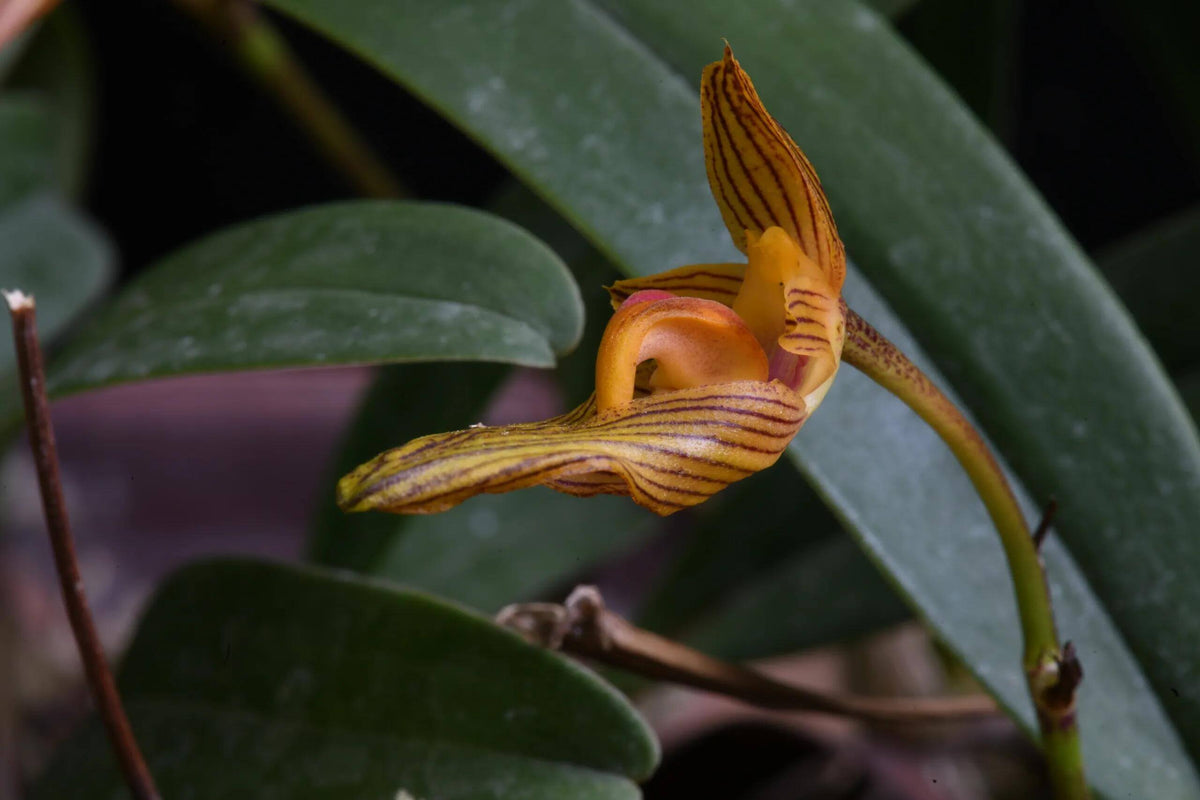
The plant has a creeping rhizome with widely spaced, ribbed, ovoid pseudobulbs, each bearing a single thick, leathery leaf. The basal inflorescence is relatively short and produces flowers successively, with usually one or two flowers open at a time. The flowers are yellow to yellow-green with brown-purple markings and have a characteristic unpleasant, fish-like fragrance.
Care Tips:
- Light: Provide bright, filtered light. Avoid strong direct midday sunlight, particularly during hot weather.
- Watering: Keep the growing medium slightly moist during active growth, but allow some drying between waterings. Avoid prolonged saturation around the roots.
- Growing Medium: Use a very airy, fast-draining orchid mix. Bark, sphagnum and perlite work well, or the plant can be mounted on cork, wood or another suitable surface.
- Humidity: Maintain around 60–80% humidity with good air circulation.
- Temperature: Warm to intermediate conditions are suitable. Approximately 18–28°C (65–82°F) is a good general range.
- Fertilizing: Apply a diluted balanced orchid fertilizer during active growth. Fertilize lightly rather than heavily.
- Airflow: Provide continuous gentle airflow, especially when humidity is high.
- Potting/Mounting: Because of its creeping rhizome and lithophytic nature, mounting or using a shallow, well-drained container can work particularly well.
- Repotting: Repot or remount when the growing medium begins to deteriorate or when the rhizome has outgrown its growing space.
- Flowering: Flowers have been recorded mainly around April–May in its natural habitat. Good light, stable moisture and active growth help encourage flowering.
Share