1
/
of
3
Begin With Plants
Paphiopedilum dianthum
Paphiopedilum dianthum
Regular price
$45.99 USD
Regular price
Sale price
$45.99 USD
Unit price
/
per
Shipping calculated at checkout.
Couldn't load pickup availability
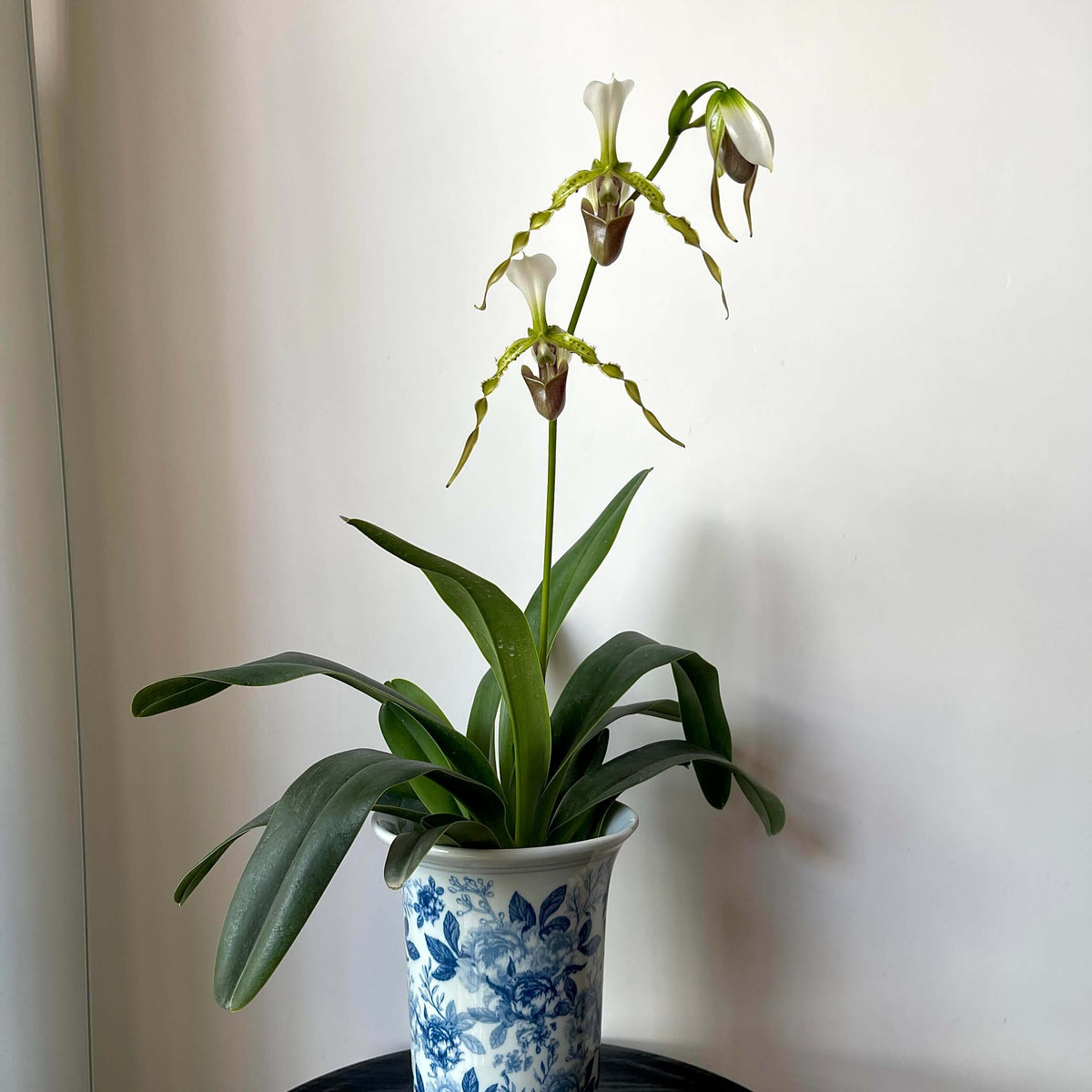
Paphiopedilum dianthum Tang & F.T.Wang is a distinctive lithophytic Paphiopedilum native to southwestern China and northern Vietnam. It grows mainly on highly eroded limestone cliffs in mossy, wet, semi-deciduous evergreen forests, generally from about 500–1,450 m elevation.
It is particularly attractive for its long, twisted, hairy-warted petals and its ability to produce several flowers simultaneously. The inflorescence is erect to arching and can carry 1–5 flowers, making a mature plant quite spectacular. The leaves are leathery, dark green above and paler beneath.
Care Tips:
- Light: Provide moderate, filtered light. Avoid strong direct midday sunlight. AOS recommends approximately 1,000–2,000 foot-candles for Paphiopedilums.
- Watering: Keep the growing medium consistently moist but not waterlogged. P. dianthum comes from wet habitats, but good drainage is still essential.
- Growing Medium: Use a moisture-retentive but airy Paphiopedilum mix containing fine or medium bark, perlite and sphagnum. Because it naturally grows on limestone, adding a small amount of calcareous material can be beneficial.
- Humidity: Moderate to high humidity is suitable, but ensure good air circulation to prevent fungal and bacterial problems.
- Temperature: This species is adaptable from warm to cool conditions. Approximately 18–28°C (65–82°F) during the day with cooler nights is a good general range.
- Fertilizing: Feed with a diluted balanced orchid fertilizer during active growth. Paphiopedilums can tolerate regular feeding, but periodically flush the medium to prevent salt accumulation.
- Airflow: Provide gentle, continuous airflow, particularly when growing in high humidity.
- Potting: Use a well-draining pot and avoid excessively large containers.
- Repotting: Repot when the growing medium begins to decompose, preferably as new roots begin to develop.
- Flowering: Good light, consistent moisture and adequate nutrition help encourage the development of its multi-flowered inflorescences.
Share