1
/
of
2
Begin With Plants
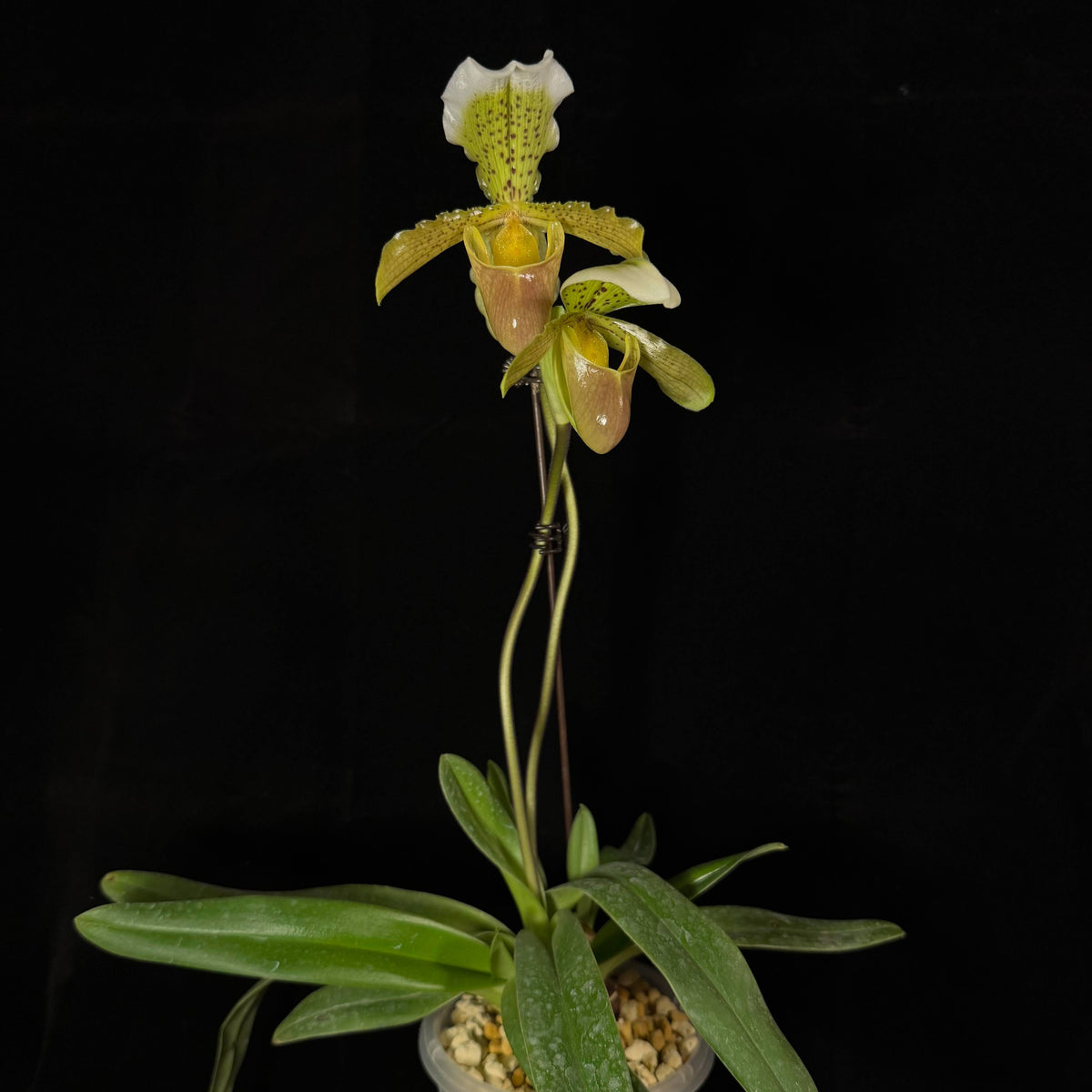
Paphiopedilum insigne
Paphiopedilum insigne
Regular price
$0.00 USD
Regular price
Sale price
$0.00 USD
Unit price
/
per
Shipping calculated at checkout.
Couldn't load pickup availability
Paphiopedilum insigne is a classic single-flowered Paphiopedilum and the type species of the genus. It is native primarily to northeastern India (Meghalaya/Assam), northwestern Yunnan in China, and Myanmar, growing in subtropical habitats at roughly 1,000–1,500 m elevation.
The plant forms a compact fan of 5–6 leathery, strap-shaped green leaves, often with purple spotting on the undersides near the base. Each growth produces a single large flower, generally around 7–12 cm across. The flowers have a pale green to yellow-green dorsal sepal with dark maroon spotting, yellow-brown petals marked with reddish-brown veins, and a yellow to yellow-green pouch with purple-brown markings.
Care Tips:
- Light: Provide bright, filtered light. A few hours of gentle shaded sunlight is beneficial, but protect the plant from strong midday sun. Around 1,000–2,000 foot-candles is generally suitable for Paphiopedilums.
- Watering: Keep the growing medium consistently lightly moist. Allow it to approach dryness between waterings, but do not let it remain completely dry for long periods. Avoid standing water and prolonged saturation.
- Growing Medium: Use a terrestrial orchid mix based on fine or medium bark with sphagnum and perlite. A small amount of crushed limestone can also be used.
- Humidity: Moderate humidity with good airflow is ideal. Avoid keeping the crown wet, especially when temperatures are cool.
- Temperature: P. insigne is relatively cool-tolerant compared with many Paphiopedilums. RHS recommends approximately 20–25°C in summer and 18–22°C in winter, while it can tolerate cooler conditions than many mottled-leaf types.
- Fertilizing: Apply a diluted orchid fertilizer regularly during active growth. RHS recommends feeding approximately every third watering.
- Airflow: Maintain gentle air movement, particularly when humidity is high.
- Potting: Use a relatively small pot with good drainage. Repot after flowering when the medium begins to deteriorate; avoid using an unnecessarily large container.
- Flowering: Avoid major changes in temperature, watering or light while the bud develops. The individual flowers can remain attractive for an extended period.
Share