Begin With Plants
Whisk fern (Psilotum nudum)
Whisk fern (Psilotum nudum)
Couldn't load pickup availability
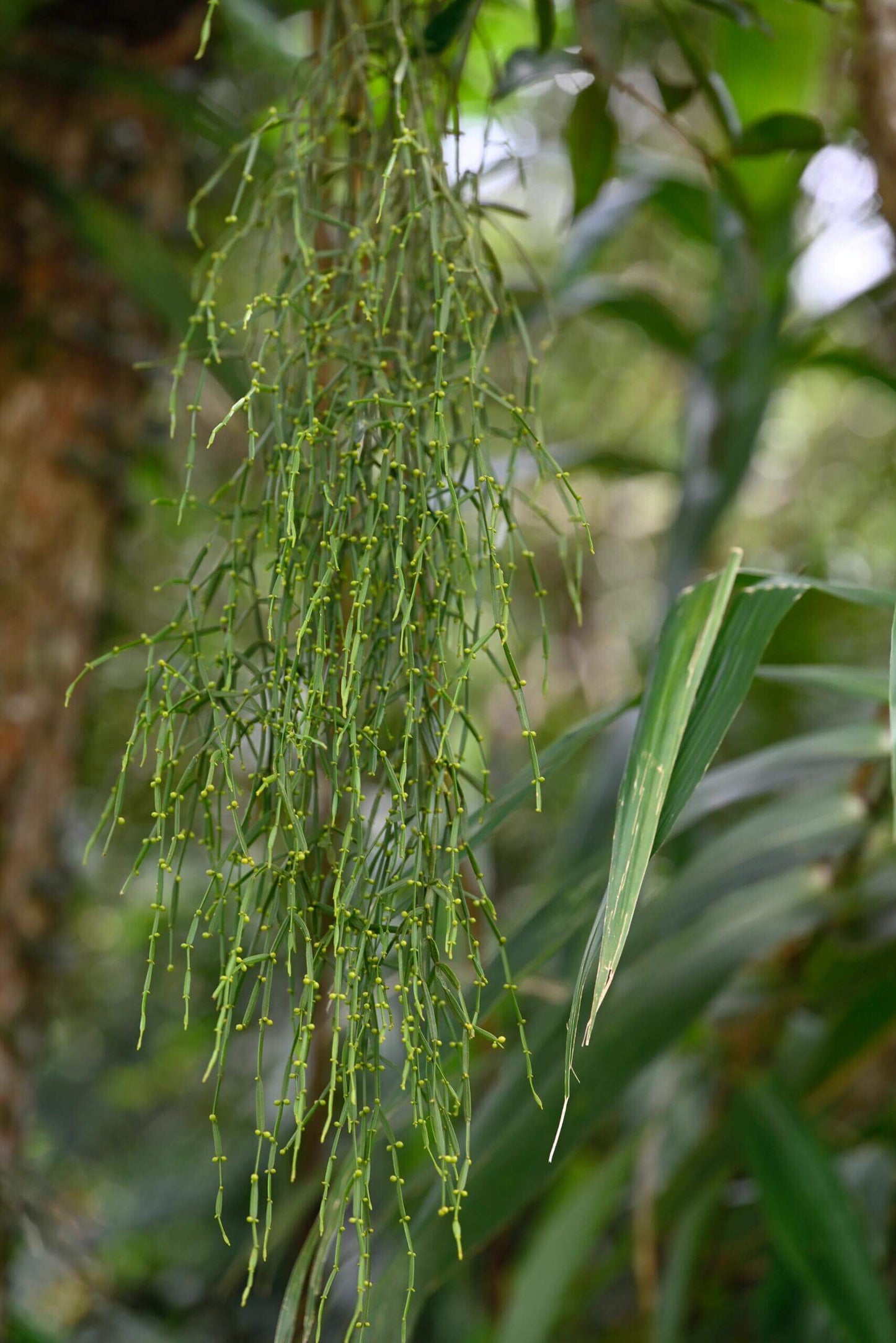
Psilotum nudum, also known as the “whisk fern,” is a primitive vascular plant in the family Psilotaceae that differs from most modern ferns and vascular plants by lacking true roots and typical leaves. The structures resembling leaves are actually greatly reduced, scale-like enations, while water and nutrients are absorbed through an underground rhizome bearing rhizoids and forming mycorrhizal associations. Its name reflects this simplicity: Psilotum derives from the Greek for “bare” or “naked,” and nudum likewise means “naked,” referring to its apparently rootless and leafless form.
Distribution & Natural Habitat:
-
Psilotum nudum has a pantropical / subtropical distribution: it is native to tropical and subtropical regions worldwide, including tropical Asia, Africa, the Americas, parts of Oceania, and even some subtropical zones such as southern Japan.
-
In the wild it can grow terrestrially (on soil, humus-rich forest floor) or epiphytically (on tree trunks/branches or in rock crevices), often in humid, shaded or partially shaded forest or woodland environments.
-
Typical mature stems may reach around 20–50 cm (or up to ~1–3 ft) depending on conditions.
Distinctive Biology & Morphology:
-
The above-ground portion is essentially a green, dichotomously-branching stem — photosynthesis and growth occur via the stems rather than via true leaves.
-
The “leaf-like” enations are tiny (often ~1–2 mm), scalelike and non-vascular — they do not function like normal leaves.
-
Reproduction is via spores, borne in yellowish (or yellow-brown) spherical synangia (fused sporangia) that form in the leaf axils or along the stems.
-
Underground, instead of true roots there is a rhizome — branching, root-like underground stem — which bears rhizoids to anchor the plant and absorb nutrients/water, often in symbiosis with fungi (mycorrhizae).
Care Tips:
-
Light: Provide bright but indirect light or partial shade. Direct, hot midday sun may be too harsh.
-
Substrate / Medium: It can grow epiphytically on bark, wood, tree trunks, or even in rock crevices — or terrestrial in humus-rich, well-draining soil with good organic matter.
-
Moisture & Humidity: Maintain consistently moist but well-draining medium — do not let it dry out completely; avoid waterlogging. High humidity and regular moisture (especially if air is dry) helps mimic its natural rainforest / subtropical habitat.
-
Temperature: Prefer warm to mild subtropical/tropical temperatures; avoid frost or cold drafts — the plant’s natural range suggests it thrives in non-freezing, humid climates.
-
Growth Habit / Mounting: Because it lacks true roots, it may cling via rhizoids — mounting on wood, bark, or growth on rock crevices can approximate its natural growth style. Epiphytic mounting often yields pendulous stems; terrestrial planting is also possible.
-
Maintenance: As a relatively hardy, low-maintenance species, it is often described as “easy.”
Share